
Published a year ago
4 mins
 
Revolutionizing Health Claims Processing
 
: Intelligent Document Processing and Machine Learning Documents


Introduction
 
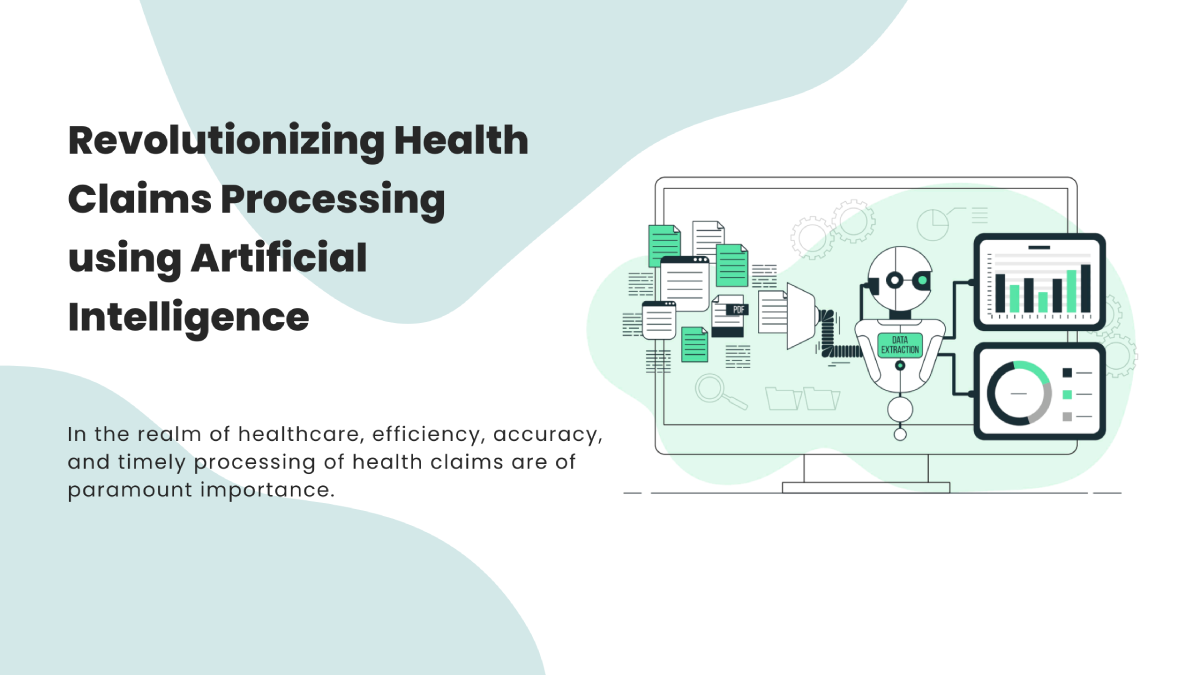
In the realm of healthcare, efficiency, accuracy, and timely processing of health claims are of paramount importance. The traditional manual methods of processing claims have often resulted in delays, errors, and inefficiencies that hinder the overall healthcare experience for both patients and providers. However, a technological revolution is underway, with Intelligent Document Processing (IDP) and Machine Learning (ML) emerging as game-changers in the field of health claims processing.
 
The Challenge of Traditional Claims Processing:
 
Traditional health claims processing involves a labor-intensive and error-prone process of manually reviewing and inputting data from various documents, including medical bills, invoices, and treatment records. This method is not only time-consuming but is also susceptible to errors, which can lead to incorrect billing, delayed reimbursements, and patient dissatisfaction. With the ever-increasing volume of claims and complex healthcare regulations, a more efficient and accurate approach is needed.
 
Machine Learning's Role in Health Claims Processing:
 
Machine Learning algorithms play a pivotal role in enhancing the capabilities of IDP systems. ML models can be trained to recognize patterns, validate data, and classify different types of documents accurately. For instance, ML algorithms can be employed to classify claims based on their nature (medical, dental, prescription, etc.), which allows for streamlined processing and appropriate routing of claims to the relevant departments.
 
Enter Intelligent Document Processing (IDP):
 
Intelligent Document Processing, powered by advancements in Optical Character Recognition (OCR), Natural Language Processing (NLP), and data extraction techniques, provides a solution to the challenges posed by manual claims processing. IDP technology can automatically extract relevant information from unstructured documents, such as medical bills and receipts, with a high degree of accuracy. This not only reduces the time required for data entry but also minimizes the risk of human errors.
 
Benefits of IDP and ML in Health Claims Processing:
 
  • Efficiency: IDP and ML significantly expedite the claims processing timeline by automating data extraction and validation. What would have taken hours or even days through manual processes can now be accomplished within minutes.
  •  
  • Accuracy: Human errors, a common concern in manual data entry, are greatly minimized. IDP and ML systems maintain a high level of accuracy, reducing the chances of billing discrepancies and claim rejection.
  •  
  • Cost Savings: By reducing the need for manual data entry and review, organizations can allocate resources more efficiently and cut down on operational costs.
  •  
  • Scalability: As the volume of health claims continues to rise, IDP and ML systems can effortlessly scale to accommodate the increased workload without compromising accuracy.
  •  
  • Compliance: Healthcare regulations are complex and ever-changing. IDP and ML systems can be configured to ensure that claims are processed in accordance with the latest regulations, minimizing compliance risks.

 
While the adoption of IDP and ML in health claims processing holds immense promise, there are challenges that must be addressed. Ensuring the security and privacy of sensitive patient data, managing the integration of these technologies into existing systems, and fine-tuning ML models to adapt to changing patterns are areas that require careful consideration.
 
In the future, we can expect continuous improvements in IDP and ML technologies, leading to even more accurate and efficient claims processing. These technologies might also facilitate the creation of predictive models, enabling healthcare providers to anticipate trends and potential issues in the claims process.In conclusion, the marriage of Intelligent Document Processing and Machine Learning is revolutionizing health claims processing. By automating data extraction, validation, and classification, these technologies are improving efficiency, accuracy, and compliance in the healthcare sector. As the healthcare industry embraces digital transformation, we can anticipate a future where health claims processing becomes a seamless and hassle-free experience for both providers and patients.
 
Scale Your Success with Confidence
 
P3Fusion is audited and certified by industry-leading third-party standards.