

We use essential cookies to make our site work. With your consent, we may also use non-essential cookies to improve user experience and analyze website traffic. By clicking “Accept,” you agree to our website's cookie use as described in our Cookie Policy and Privacy Policy. You can change your cookie settings at any time by clicking “Preferences.”
 
 
Multi-Location Home Services Franchise Network - Salesforce Contact Center with Amazon Connect
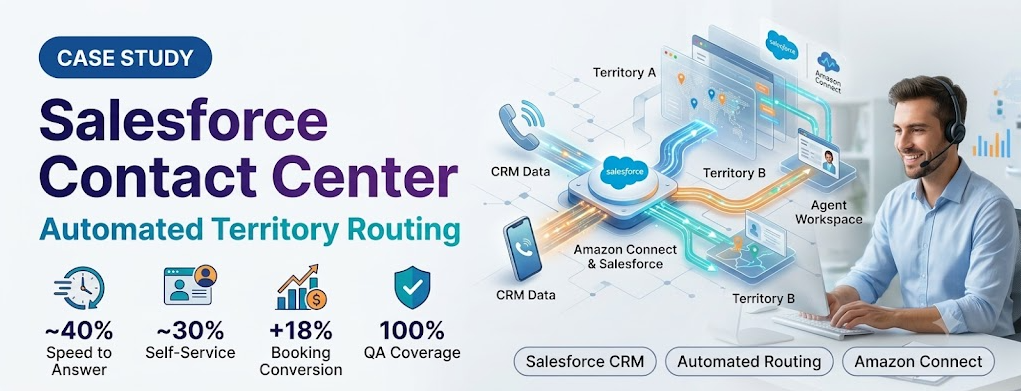
~40% Reduction in Average Speed to Answer
Automated Territory Routing Across Hundreds of Franchises
100% Automated QA & Call Transcription via Contact Lens


Case Study · Salesforce Contact Center with Amazon Connect
Multi-Location Home Services Franchise Network
Voice modernisation, territory routing, CRM-native reporting
 
A Canadian home services brand operating a franchise network across hundreds of territories runs its entire revenue motion through the phone. Every missed call is a lost booking. The business was running a legacy hosted PBX bolted onto Salesforce through a third-party CTI adapter, with no reliable view of what happened on a call once it ended.
 
We consolidated telephony and CRM onto Salesforce Contact Center with Amazon Connect (SCC-AC), retiring the PBX and the adapter in favour of a single natively integrated stack administered entirely from Salesforce.
 
CORE OPERATIONAL SHIFT
"When a customer calls, the system recognises their number before anyone picks up, asks in plain language what they need, and routes them to the correct franchise territory automatically. The agent's screen opens on that customer's record with address, job history and open quotes already loaded. Nothing is retyped, and nothing is lost."
 
The Challenge
 
In home services, inbound phone calls drive immediate bookings. When customer data and voice lines are disconnected, franchise revenue and customer trust are compromised at scale.
 
The Pain Point: Disjointed Systems & Franchise Misroutes
 
Call volume swung three-fold between the off-season and peak. Agents juggled a softphone in one window and Salesforce in another, retyping customer details mid-call. Franchise owners could not tell whether a lead was lost to a long hold or a poor handoff, because call data lived in one system and booking data in another:
The Legacy Inbound Friction Chain:
Customer calls inbound➔Brittle CTI adapter delay➔Agent asks for name & postal code➔Manual retyping & territory misroute
Peak-sized seat licenses were maintained year-round, quality assurance was limited to sampling a tiny two percent of calls, and franchise owners lacked reliable attribution data on marketing leads.
 
 
Key Challenges
 
🔌
Disconnected Stacks
 
Separate telephony and CRM platforms joined by a brittle third-party CTI adapter that frequently dropped session context and required dual administration.
📋
No Screen Pop
 
Agents opened every call by asking for caller name and service address, retyping details mid-conversation while callers waited on hold.
🗺️
Manual Territory Routing
 
Franchise territory boundaries were resolved manually, causing frequent misroutes, internal cold transfers, and abandoned high-intent leads.
💰
Seasonal Over-Provisioning
 
Call volumes swung 3x between peak summer and off-season, forcing the business to carry peak-sized license and seat counts all year long.
🎙️
No Transcription Coverage
 
Quality reviews relied on hand-sampling merely two percent of recorded calls, leaving 98% of customer interactions unmonitored for coaching or compliance.
📊
Fragmented Reporting
 
Two vendors and two isolated datasets meant there were no shared identifiers linking call records to booked jobs, preventing accurate marketing attribution.
 
 
How the Solution Works — In Plain Terms
 
A unified contact center built on Amazon Connect natively embedded in Salesforce Service Cloud, transforming every customer touchpoint into an instant booking opportunity.
 
Step 01
Instant Caller Identification & Natural Language Intent

When a customer calls, the system matches their number against Salesforce Contacts, Leads, and Accounts before anyone picks up. An Amazon Lex bot captures intent in natural language — whether a new booking, reschedule, billing query, or complaint. Known callers bypass repetitive identification.

Step 02
Automated Territory & Skill-Based Routing

The customer's postal code and requested service type dynamically resolve the exact franchise territory. Salesforce Omni-Channel routes the call directly to an available agent skilled for that region, eliminating manual transfers.

Step 03
High-Efficiency Self-Service Containment

Routine inquiries — such as job status, appointment confirmation, and operating hours — are resolved automatically in self-service by Amazon Lex and never require agent time, freeing agents to focus on high-value revenue bookings.

Step 04
Screen Pop, Live Transcription & Auto-Logging

When connected, the agent's screen opens immediately on the customer record with address, job history, and open quotes preloaded. Contact Lens transcribes the call live, monitoring sentiment and keywords. Post-call, an auto-summary and recording automatically link to the Salesforce Voice Call record.
 
 
Solution Workflow
 
From inbound ring to booked dispatch, every step is synchronized natively between Amazon Connect and Salesforce.
 
PHASE 1
 
Inbound & Intake
 
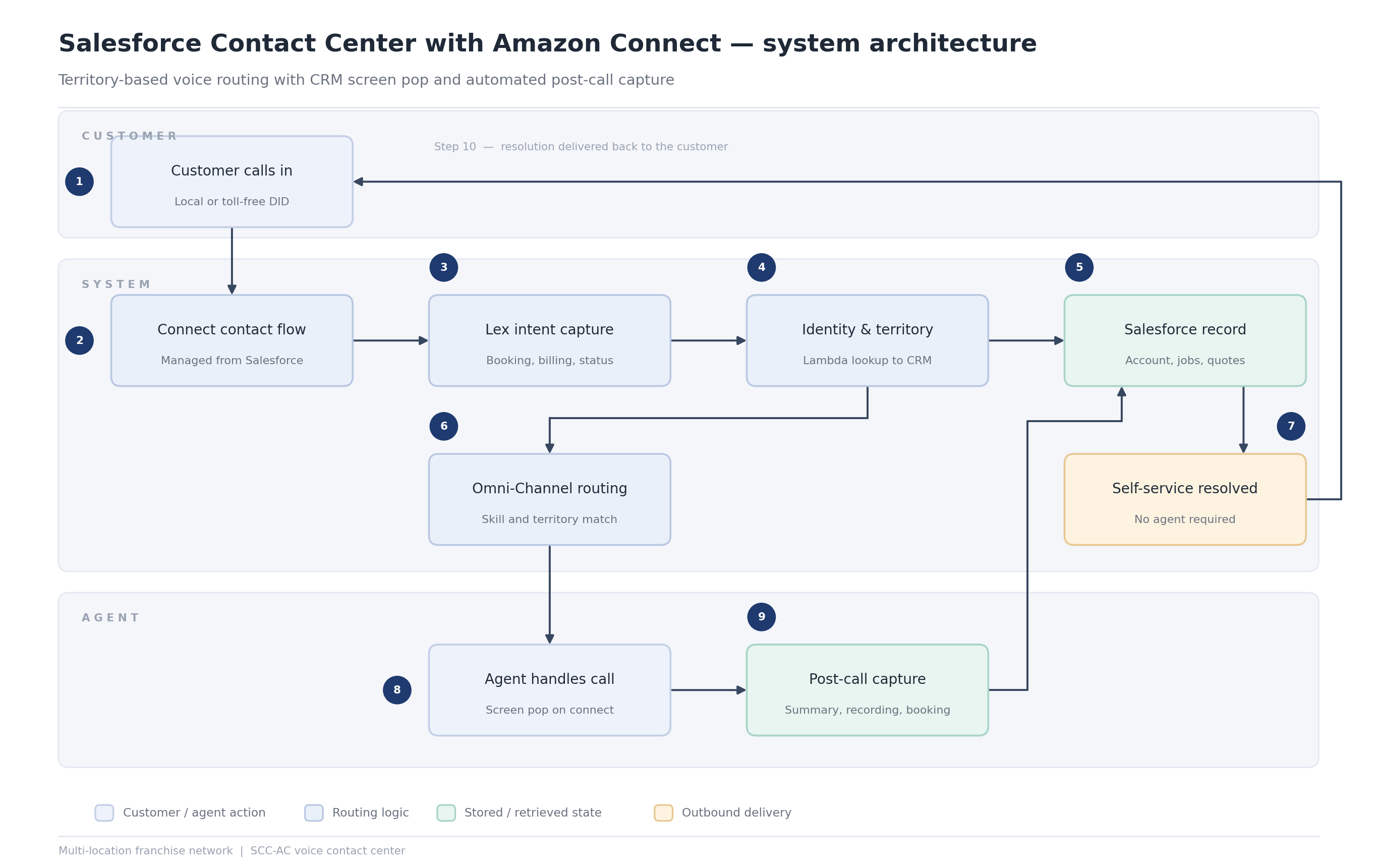
Calls arrive on local or toll-free numbers. Amazon Lex captures intent, matches Caller ID via Lambda into Salesforce, and resolves postal code territory.
 
➔ Known callers skip verification.
PHASE 2
 
Omni-Channel Routing
 
Simple inquiries contain in Lex self-service. Complex bookings route via Salesforce Omni-Channel with instant screen pop in Service Cloud Voice.
 
✓ Zero retyping. Screen loaded upon pick-up.
PHASE 3
 
Live QA & Auto-Summary
 
Live transcription runs with sentiment alerts. Bookings trigger downstream scheduling, while recordings and auto-summaries land on the Voice Call record.
 
➔ 100% automated call logging & dispatch.
 
"The booking is created in Salesforce during the call, instantly triggering downstream scheduling and franchise technician dispatch without manual intervention."
 
 
Architecture Workflow
 
Figure 1 — Inbound voice architecture: Amazon Connect telephony bridged natively into Salesforce Omni-Channel under SCC-AC.
 
Multi-Location Franchise Inbound Voice Architecture with Amazon Connect and Salesforce
Preview
 
Six-Layer Architectural Breakdown
 
Layer 1
Telephony Layer

Amazon Connect instance provisioned and licensed through Salesforce under SCC-AC. Phone numbers, contact flows, and operational profiles are administered directly from Salesforce Setup.

Layer 2
Conversational Layer

Amazon Lex captures caller intent and fills slots in natural language (booking, reschedule, status inquiry), with built-in confidence-based fallback to live agent queues.

Layer 3
Integration Layer

AWS Lambda calls Salesforce REST APIs in real time for caller identification, franchise territory resolution, and account enrichment, returning values as Connect contact attributes.

Layer 4
Routing Layer

Contact attributes drive native Salesforce Omni-Channel routing. Agents handle calls inside the native Service Cloud Voice softphone with no third-party CTI adapter.

Layer 5
Intelligence Layer

Contact Lens enables real-time call transcription, sentiment analysis, and keyword alerts. Amazon Q in Connect automatically surfaces relevant knowledge articles mid-call.

Layer 6
Data & Reporting Layer

Audio recordings and transcripts in Amazon S3 link directly to Salesforce Voice Call records. Unified dashboards combine Connect, CloudWatch, and Salesforce booking data.

 
Success Metrics
 
Measurable operational improvements delivered through native telephony and CRM unification.
 
~40%
Speed to Answer
Reduced hold times
~30%
Self-Service
Resolved without agent
+18%
Booking Conversion
On inbound calls
100%
QA Coverage
From 2% sample
 
 
Operational Transformation: Before vs. After
Operational MetricMeasured ResultBusiness Impact
Average speed to answerReduced ~40%Dramatically lower abandonment on inbound revenue calls
Average handle time (AHT)Reduced ~20–25%Instant screen pop eliminates manual identity & address retyping
Self-service containment~30% resolved without agentRoutine job status, confirmation & hours handled by Lex bot
Booking conversion on inbound callsUp ~15–18%Calls route immediately to right local territory with context loaded
Misroutes to wrong territoryDown ~45%Postal code & service type dynamic territory resolution
Quality review coverage2% sampled to 100% automatedContact Lens real-time transcription, keyword & sentiment alerting
Agent onboarding timeCut by roughly halfSingle Service Cloud console replaces separate softphone and CRM
Telephony run costDown ~25%Consumption-based pricing retired fixed PBX maintenance contracts
Peak-season scaling3x volume absorbed effortlesslyElastic cloud capacity without carrying peak-sized year-round licensing
Platform vendors to manageTwo reduced to oneUnified administration from Salesforce Setup under SCC-AC
 
 
Our Experience with SCC-AC
 
We have delivered Amazon Connect and Salesforce Contact Center implementations across home services franchise networks, digital health and member engagement, moving and logistics, and multi-brand service organisations.
 
Turnkey PBX & CTI Migration
 
Retire legacy hosted PBX systems and brittle third-party CTI connectors in favour of direct cloud telephony embedded inside Salesforce Service Cloud Voice.
Dynamic Territory Routing
 
Automate complex routing based on postal code polygons, agent skills, franchise licensing, and operating hours, resolving misroutes before calls ring.
Elastic Pay-As-You-Go Scale
 
Absorb 3x seasonal call volume spikes smoothly without purchasing idle licenses or locked seat tiers during low-volume seasons.
 
 
* Metrics shown are representative of outcomes across engagements of this type. Customer names are withheld for confidentiality.
Scale Your Success with Confidence
 
P3Fusion is audited and certified by industry-leading third-party standards.