AWS Gen AI Competency
InsightBot RAG
MetroNational Turns Contractor Bids into a Data-Driven Competitive Advantage with InsightBot RAG
 
MetroNational, one of Houston's leading real estate developers, was evaluating contractor bids the same way every developer does — manually, slowly, and without the benefit of years of historical data. InsightBot changed all of that by making every past bid, quote, and contractor pattern instantly retrievable, comparable, and actionable.
 
InsightBot RAG
Amazon Bedrock
MetroNational · Houston TX
Bid Management
Historical Data Intelligence
Multi-Corpus Analysis
 
 
Results at a Glance
 
Customer: MetroNational · Location: Houston, Texas · Industry: Real Estate Development · Platform: InsightBot on Amazon Bedrock · Deployment: 8 weeks


Executive Summary
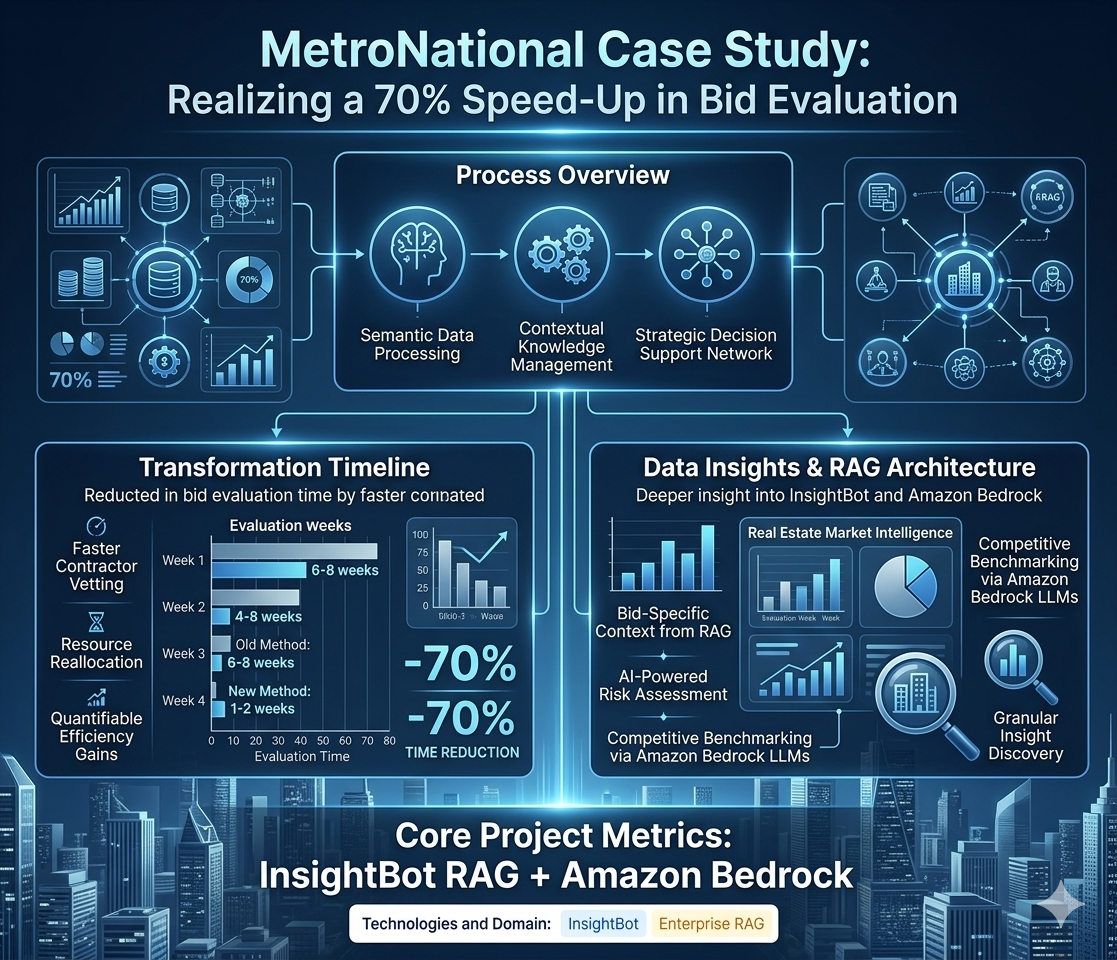
MetroNational is one of Houston's most active real estate developers — building, owning, and managing commercial, medical, hospitality, multifamily, and retail properties across the city, anchored by their landmark Memorial City development. Every major project involves evaluating bids from multiple contractors across dozens of scopes of work. For years, this process relied on manual review, spreadsheets, and institutional memory — with no systematic way to tap into the firm's rich archive of historical bids, past contractor performance, and pricing patterns. P3Fusion deployed InsightBot, its enterprise RAG (Retrieval-Augmented Generation) platform on Amazon Bedrock, to transform this entirely. By indexing MetroNational's complete historical archive of bids, quotes, contracts, and scope documents into a unified, intelligent knowledge layer, InsightBot gave the procurement and project management teams the ability to instantly retrieve, compare, and analyse any past bid — and use those insights to ask sharper questions of current bidders, negotiate from a position of data, and identify contractor patterns that would otherwise take years of experience to accumulate. Bid evaluation time dropped by 70%. Every procurement decision is now supported by historical evidence. And the quality of MetroNational's negotiations changed fundamentally — from reactive to data-driven.
About MetroNational
Seven Decades of Building Houston — and a Bid Archive to Match
MetroNational has been shaping Houston's built environment since 1947. Today the company develops and manages a diverse portfolio spanning corporate headquarters, medical campuses, retail and restaurant destinations, hospitality properties, and multifamily communities — with Memorial City, one of Houston's most significant urban mixed-use districts, as their flagship development.
 
Every property in that portfolio began as a construction project. And every construction project involved evaluating bids. Over decades of activity, MetroNational accumulated an enormous archive of contractor proposals, scope documents, unit price lists, change order histories, and final contract values — an invaluable record of what things cost, which contractors delivered, and where the risks historically lived. The challenge was that this archive existed in folders, filing cabinets, and disconnected systems. No one could query it. No one could learn from it systematically. Every new bid cycle started almost from scratch.
 
The Challenge
Billions of Dollars in Projects. Bids Evaluated Without the Benefit of History.
When MetroNational received bids for a new development — whether a medical office building, a hotel, or a multifamily complex — the procurement team faced the same challenge every time: how do you quickly and confidently evaluate three, five, or eight competing contractor proposals when the context you need is buried in years of historical documents that nobody can efficiently access?
 
Experienced project managers carried institutional knowledge in their heads. They knew, from memory, which subcontractors had come in high on concrete work historically, or which general contractors had a pattern of front-loading their bids. But that knowledge was fragile — it walked out the door with people, it was inconsistently shared, and it could never be applied systematically across multiple simultaneous projects. And for newer team members, it simply did not exist at all.
 
01
No way to search historical bids

Years of contractor proposals, scope documents, and unit price lists existed in disconnected folders. Retrieving a relevant past bid for comparison meant hours of manual searching — or asking the right person if they happened to remember it.

02
Choosing between bids was slow and subjective

Comparing multiple bids across dozens of line items — while trying to account for scope differences, exclusions, and unit price variations — was a time-consuming manual process that relied heavily on individual judgment rather than systematic data.

03
Negotiations lacked data backing

When sitting across the table from a contractor, MetroNational's team often negotiated from instinct. Without ready access to what that same contractor had bid on similar scopes previously, or where market pricing actually sat, leverage was limited.

04
Hidden patterns were invisible

Contractor behaviours — bid inflation patterns, scope exclusion strategies, unit price trends — existed in the data but nobody could see them. Analysis that should take minutes was taking days, or simply was not happening at all.

We had years of valuable bid data sitting in files that nobody could use in real time. Every new bid cycle, we were starting almost blind — even though the answers to our questions were somewhere in our own archive.

— Director of Project Management, MetroNational

 
Why RAG — and Why Now
This Problem Has a Name: It's a RAG Problem
Retrieval-Augmented Generation — RAG — is a technique where an AI system retrieves relevant information from a specific knowledge base before generating a response. Unlike a general-purpose AI that answers from training data, a RAG system grounds every answer in your documents — your bids, your contracts, your historical data — and cites exactly where each piece of information came from.
 
MetroNational's bid management challenge was a textbook RAG use case. The knowledge they needed existed — in their own archive. What they lacked was the ability to retrieve it instantly, connect it across documents, and generate insights from it at the speed of a procurement decision. RAG is precisely what turns a static document archive into a live intelligence engine.
How RAG Works for MetroNational's Bid Management
📥
All bids & contracts indexed

Every historical bid, quote, scope, and contract ingested into InsightBot's RAG knowledge base via Amazon Bedrock

🔍
Question asked in plain language

"What did Contractor X bid on structural steel for the last three projects?" RAG retrieves the exact documents

🔗
Connected analysis generated

RAG synthesises across all relevant documents — comparing, contrasting, and surfacing patterns automatically

Cited, data-backed answer

Every insight is traceable to its source document — ready to use in a negotiation or selection decision

P3Fusion's InsightBot brought production-grade RAG to MetroNational's bid management workflow on Amazon Bedrock — the only platform that combined the depth of retrieval needed across a large, multi-format historical archive with the enterprise access controls and auditability a development firm requires.
 
The Solution
InsightBot: Every Bid in MetroNational's History, Instantly Queryable
P3Fusion deployed InsightBot in 8 weeks, indexing MetroNational's complete bid archive — contractor proposals, scope of work documents, unit price schedules, RFP responses, executed contracts, and change order logs — into a unified RAG knowledge base on Amazon Bedrock. The ingestion pipeline handled the full range of formats MetroNational's archive contained: PDFs of scanned proposals, Excel unit price schedules, Word scope documents, and email-attached quotes.
 
The result was something MetroNational had never had before: a single place to ask any question about any past bid, and get an instant, cited, accurate answer drawn from the actual documents.
 
Retrieve anything, instantly. "Show me every concrete bid from the last five years for projects over $10M" — a query that previously would have taken a team member half a day to answer manually — now returns a complete, sourced summary in seconds. Every answer traces back to the specific document and line item it came from, so the procurement team can verify and drill deeper as needed.
 
Compare bids across every dimension. InsightBot's connected analysis capability draws simultaneously across multiple documents — comparing Contractor A's current bid against their past three proposals, against Contractor B's current bid, and against the market pricing range visible from all historical data. What used to require a custom spreadsheet built over hours now happens in a single query.
 
Ask the right questions of bidders. With InsightBot surfacing what each contractor had historically included or excluded from their scopes, MetroNational's team could walk into a bid clarification meeting with specific, targeted questions — "your last two bids excluded temporary power; is that the case here?" — rather than discovering scope gaps after award.
 
Negotiate from data, not instinct. When a contractor's bid came in 18% above historical benchmarks for similar scope, InsightBot could surface that benchmark instantly — giving MetroNational's negotiators a specific, documented data point to anchor the conversation. Negotiations moved from "we think this feels high" to "based on three comparable projects, the market range for this scope is X."
// Hidden Pattern Discovered via RAG

Within the first month of deployment, InsightBot's analysis of MetroNational's historical bid archive surfaced a pattern that had never been formally identified: a specific category of MEP subcontractor bids consistently ran 12–15% below final contract value on projects over a certain complexity threshold — a systematic underpricing pattern that had historically led to cost escalation through change orders. The RAG analysis across 40+ historical bids made this pattern visible in a single query. MetroNational now applies an evidence-based adjustment factor when evaluating this category — a risk insight that came directly from their own data, made visible for the first time by RAG.

 
Advantages Delivered
From Blind Decisions to Data-Driven Procurement
70% faster bid evaluation

What took days of manual review and spreadsheet building now happens in hours. Teams can evaluate more bids, with greater depth, in less time — improving both decision quality and project timelines.

🔗
Connected analysis across all documents

InsightBot reads across current bids, historical proposals, contracts, and change orders simultaneously — synthesising a complete picture that no individual could assemble manually in the time available.

📋
Sharper questions, better bids

Historical scope analysis means MetroNational's team knows exactly what to look for — and what to ask — before issuing an RFP. Better-informed bid requests attract more comparable, competitive responses.

💬
Data-driven negotiations

Every negotiation is now anchored to historical evidence from MetroNational's own procurement history. Contractors know they are dealing with a counterpart who has data — which improves both pricing outcomes and relationship quality.

🔍
Hidden patterns surfaced

RAG analysis across the full historical archive reveals contractor behaviour patterns, pricing trends, and scope risk signals that were invisible before — turning years of past data into forward-looking risk intelligence.

🎓
Institutional knowledge preserved

The expertise that used to live in senior team members' memories is now encoded in the RAG knowledge base. New project managers have access to the same historical intelligence from day one — regardless of tenure.

Every decision auditable

InsightBot cites every source document for every insight it surfaces. Procurement decisions have a documented evidence trail — valuable for internal governance, board reporting, and any future dispute resolution.

📈
3× more bids analysed per project

With evaluation time cut by 70%, MetroNational's team can now analyse three times as many competing bids per project cycle — driving more competition, better pricing, and a wider view of the contractor market.

 
Before & After
The Measurable Shift
Before InsightBot
Days
Time to manually compare multiple contractor bids across historical context
Memory
Primary source of historical bid intelligence — fragile and inconsistent
Instinct
Basis for negotiation — without data to back specific positions
Hidden
Contractor patterns and pricing risks buried in years of unqueryable documents
After InsightBot
Hours
Full multi-bid analysis with historical context — 70% faster
RAG Data
Every historical bid instantly queryable — cited, accurate, available to all
Evidence
Negotiations anchored to historical benchmarks from MetroNational's own archive
Visible
Patterns surfaced automatically across the full document corpus via RAG analysis
 
Results
Procurement That Gets Smarter With Every Project
70%
Faster bid evaluation
Days → hours per bid cycle
More bids analysed per project
More competition, better pricing
100%
Decisions backed by data
Every decision has a documented evidence trail
The shift at MetroNational has been cultural as much as operational. Procurement conversations that used to begin with "what do we remember about this contractor?" now begin with "what does InsightBot show us about this contractor?" The data is the starting point — not an afterthought. And because InsightBot learns from every new bid that enters the system, MetroNational's competitive intelligence compounds over time: every project makes the next one smarter.

InsightBot gave us something we never had — the ability to use our own history as an asset. Every bid we've ever received is now working for us. It's changed how we think about procurement entirely.

— VP of Development, MetroNational

 
Next Steps
Expanding RAG Across the Full Development Lifecycle
Building on InsightBot's success in bid management, MetroNational and P3Fusion are expanding the RAG knowledge base to cover the full development lifecycle — including executed contracts, project schedules, change order logs, closeout documentation, and tenant lease abstracts. The next phase will enable project managers to ask questions that span from pre-development feasibility through construction completion and into asset operations — turning MetroNational's complete institutional knowledge into a single, queryable intelligence layer that every team member can access from day one.
About MetroNational
MetroNational
metronational.com
Founded1947
HQHouston, Texas
FlagshipMemorial City, Houston
SectorsOffice, Medical, Retail, Hospitality, Multifamily
NotableCityCentre, M-K-T Heights acquisitions 2026
 
Engagement Details
PlatformInsightBot RAG
Deployment8 weeks
Use caseBid management & analysis
Data indexedHistorical bids, contracts, scopes
FormatsPDF, Excel, Word, email
AWS foundationAmazon Bedrock RAG
 
AWS Services
Amazon Bedrock
Titan Embeddings V2
Bedrock Guardrails
pgvector · PostgreSQL
Amazon ECS (Fargate)
Amazon Cognito
Amazon S3
Amazon CloudWatch
 
P3Fusion

AWS Generative AI Competency Partner. InsightBot is P3Fusion's enterprise RAG platform — turning any organisation's historical documents into a live, queryable intelligence engine on Amazon Bedrock.

Gen AI Competency
Connect SDP
Bedrock
RAG
pgvector

See how InsightBot turns your document archive into a live intelligence engine on Amazon Bedrock.


 
More Case Studies
 
 
Scale Your Success with Confidence
 
P3Fusion is audited and certified by industry-leading third-party standards.