We use essential cookies to make our site work. With your consent, we may also use non-essential cookies to improve user experience and analyze website traffic. By clicking “Accept,” you agree to our website's cookie use as described in our Cookie Policy. You can change your cookie settings at any time by clicking “Preferences.”
Zero missed calls due to routing — calls follow the agent, not the workstation
100% of loyal customers reach their specific agent, every time
80% reduction in IT configuration requests
Overview
This client operates a customer-facing call center supporting a workforce that frequently moves between offices, warehouses, and on-site facilities. Employees working on factory floors or at client sites could not carry a laptop with them, so when a customer called, the system routed it to an empty workstation — the phone rang out, and the customer hung up.
Workforce Mobility and Customer Connectivity
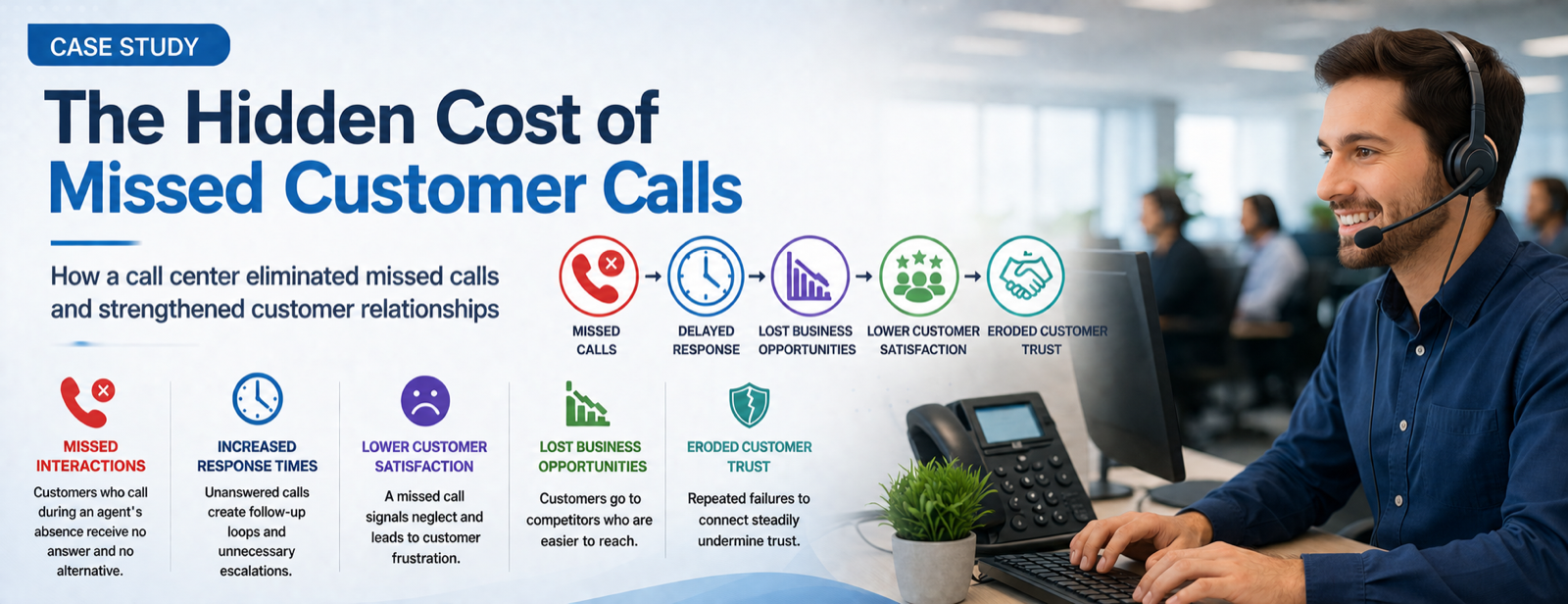
Missed Interactions
Customers who called during an agent's absence received no answer and no alternative — leaving them without the help they needed.
Lost Business Opportunities
In a competitive market, a customer who could not reach the right person would find someone who could.
Eroded Customer Trust
Repeated failures to connect — especially for loyal customers expecting a personal relationship — steadily undermined trust built over years.
Business Challenge
A customer support organization with a highly mobile workforce faced a recurring challenge in managing incoming customer calls. Employees frequently moved between offices, warehouses, operational facilities, and customer locations as part of their daily responsibilities, making it difficult to remain at their assigned workstations.
Although incoming calls were routed to the employees' designated desk phones, many went unanswered when employees were away from their desks. This resulted in missed customer interactions, longer wait times, increased call abandonment, and a less consistent customer experience. The organization needed a solution that would allow employees to stay reachable regardless of their location, without disrupting existing workflows.
Solution
To address this challenge, the organization implemented an intelligent call-routing solution that dynamically directed incoming calls based on each employee's real-time availability and active device.
Instead of allowing calls to ring at an unattended workstation, the system automatically routed them to the employee's available device—whether a desk phone, softphone, or mobile device. By leveraging real-time presence and device-awareness, the solution ensured that employees could remain connected while moving between work locations, enabling seamless communication without requiring manual intervention.
Scenario A: On the desk
Before leaving the workstation, an employee working in an operational area switches call handling to a mobile device in just a few seconds. When a customer calls, the call is routed directly to the employee's mobile device, allowing it to be answered seamlessly without interruption.
Scenario B: The Loyal Customer
A returning customer prefers to speak with their dedicated account representative. When the customer calls, the system intelligently routes the call to the representative's active device, even if they are away from their desk in a meeting or another work location. This ensures continuity of service and helps maintain a strong customer relationship.
Before vs. After — The Operational Difference
Without This Solution
When an employee was away from their workstation, incoming customer calls continued to ring at an unattended desk, resulting in unanswered calls, repeated customer attempts, and missed service opportunities. Customers who preferred speaking with a familiar representative were often redirected to another available employee, requiring them to repeat their information and reducing the continuity of their experience.
In addition, changing call-routing preferences often depended on IT support or administrative assistance, creating unnecessary delays and limiting employees' ability to respond quickly to changing work locations.
With This Solution
Incoming calls are intelligently routed to the employee's active device, allowing them to remain reachable whether they are at their desk, in a meeting, or working in another location. Returning customers can continue to connect with their preferred representative, ensuring consistent and personalized service experience.
Employees can update their call-routing preferences in just a few moments through a self-service application, eliminating the need for IT intervention. This enables faster response times, greater workforce mobility, improved operational efficiency, and a seamless customer experience.
Results
Zero Missed Calls Due to Routing
Calls follow the agent, not the workstation.
100% Loyal Customers Reach Their Agent
The right person, every time.
<30s to Switch Call Mode
What once required an IT request now takes seconds.
80% Reduction in IT Configuration Requests
Agents self-serve without support involvement.
Full Agent Visibility of Own Setup
No uncertainty about the current routing mode.
Key Learnings
Mobility Is Now a Baseline Expectation
In industries where employees move, the tools must move with them. Routing flexibility is a prerequisite for consistent service, not a convenience.
Customer Relationships Require Consistent Points of Contact
Allowing customers to reliably reach their agent treats the relationship as an asset, not a transaction.
Self-Service Reduces Friction for Everyone
Empowering agents to manage their own settings removes a persistent source of delay and reduces IT workload.
Simplicity Determines Whether a Tool Gets Used
An agent who has never seen the tool before understands it immediately — that simplicity was a deliberate design decision.
Architecture
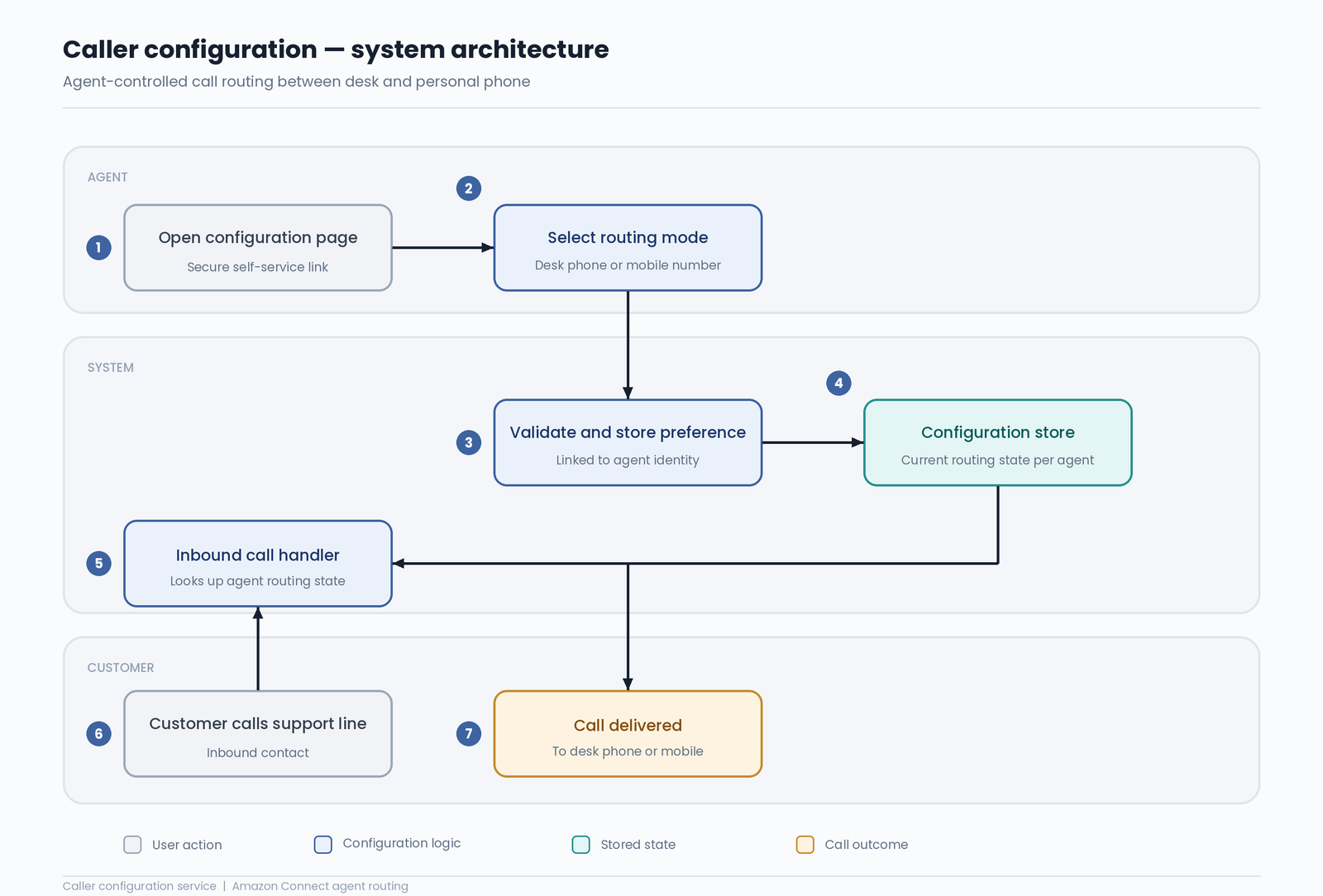
Caller configuration system architecture: agent self-service page → validation service → Lambda → configuration store → inbound call handler routes to desk phone or mobile.
Preview
• Agent Configuration Interface:
A secure, self-service webpage that agents open to manage their own call routing, with built-in validation to catch invalid phone numbers before saving.
• Configuration Validation Service:
Validates the phone number format, confirms the routing mode, and prepares the record to be stored, ensuring only valid, complete configurations are ever saved.
• AWS Lambda:
Handles the end-to-end logic of the request — authenticating it, reading and writing the agent's configuration, and serving the interface itself.
• Configuration Store (Amazon Connect Tags):
The agent's routing preference is stored as tags directly on their Amazon Connect agent resource — no separate database required.
• Amazon Connect Contact Flow:
When a customer call arrives, the contact flow checks the agent's stored configuration tags and routes the call accordingly, automatically and without manual intervention.
ConclusionWhen a loyal customer calls and reaches the person they know — without friction, without being redirected, without having to explain themselves — that experience reinforces trust. The right agent, the right device, every call.
Scale Your Success with Confidence
P3Fusion is audited and certified by industry-leading third-party standards.