
We use essential cookies to make our site work. With your consent, we may also use non-essential cookies to improve user experience and analyze website traffic. By clicking “Accept,” you agree to our website's cookie use as described in our Cookie Policy and Privacy Policy. You can change your cookie settings at any time by clicking “Preferences.”
 
 
Industrial IoT Predictive Maintenance Platform
473,637 Smart Locks Monitored Continuously
2,894 Facilities Protected Across the Network
< 5 Min from Failure to Detection


Case Study · Industrial AI & Predictive Maintenance
From Reactive to Predictive: AI That Fixes Problems Before Tenants Notice
 
Every device failure in a self-storage facility used to follow the same path: a tenant arrives, discovers they cannot access their unit, calls the facility manager, the facility manager calls support, support investigates across multiple systems, and eventually a technician is dispatched. The entire chain — from failure to resolution — depended on a tenant complaint to start.
 
P3Fusion Engineering reimagined this entirely. We built an AI-powered platform that continuously monitors every device across a network of thousands of facilities, decides in real time whether to resolve an issue automatically, escalate it to a human agent with full context, or warn about it before it has even crossed a failure threshold.
 
CORE OPERATIONAL SHIFT
"The system does not wait for something to break. It watches every device, thinks about what it sees, and acts — all within five minutes, around the clock."
 
The Challenge
 
Our client operates one of the world's largest smart-access platforms for the self-storage industry. With nearly half a million IoT devices, their scale creates a maintenance problem that human processes simply cannot keep up with.
 
The Old Model: Reactive, Slow, Expensive
 
Before this platform, the only way the team knew about a device problem was when it had already caused a tenant impact. A dead battery, a credential error, a misconfigured device setting — all of these became visible only at the moment a tenant could not get in. At that point, the support response was slow by design:
The Legacy Reactive Chain:
Tenant can't access unit➔Calls facility manager➔Manager calls support➔Agent investigates manually➔Technician dispatched
At scale, this model was unsustainable. Software-fixable issues — credential errors, settings mismatches, firmware drift — were generating unnecessary technician visits. Support agents were spending minutes per call gathering context that should have been instant. And nobody was watching for devices that were quietly trending toward failure.
 
 
Key Challenges
 
⏱
No Visibility Until Failure
 
Devices failed silently. There was no monitoring layer — the first signal of a problem was a tenant complaint, often hours or days after the condition first occurred.
🔍
Agents Lacked Instant Context
 
When a support call came in, agents manually searched across multiple systems to piece together device history, facility contacts, and recommended actions. Every call took longer than it needed to.
🔧
Software Issues Triggered Physical Visits
 
A large proportion of device issues were software-fixable — credential resets, setting corrections, firmware updates — but they were being resolved through expensive technician dispatches because no automation existed.
🔮
No Predictive Capability
 
Battery voltage declines gradually for weeks before failure. Connectivity patterns degrade before a gateway goes offline. These signals were visible in the data but nobody was reading them. Every failure was a surprise.
 
 
How the Solution Works — In Plain Terms
 
The platform operates in four modes simultaneously, all running on AWS without touching or modifying the client's existing core infrastructure.
 
Mode 01
It Watches Everything, Continuously

A monitoring engine evaluates every device across the entire network every five minutes. It checks voltage levels, connectivity state, credential status, firmware versions, and dozens of other signals against 22 defined alert conditions. When a condition is met, an alert is created instantly — not when someone calls in.

Mode 02
It Fixes What It Can, Automatically

When an alert fires and the issue is software-fixable, the platform sends the corrective command directly to the device — no human involved. Credential resets, settings corrections, firmware pushes. If the first command does not work, it retries automatically over 50 minutes. Most issues are resolved before anyone is aware they occurred.

Mode 03
It Makes Every Agent an Expert Instantly

When an issue requires a human — a physical breach, a hardware failure, something the platform cannot fix alone — a task appears in the support agent's workspace. Before the agent types a single word, a generative AI assistant has already read the alert, retrieved the device history, identified the facility contact, and prepared a recommended action. The agent acts in seconds, not minutes.

Mode 04
It Predicts Failures Before They Happen

Three custom machine learning models — trained on the client's own historical device data — score every device in the fleet daily. A battery declining at a specific rate gets flagged three weeks before it fails. A gateway showing degraded connectivity patterns gets flagged 24 hours before it goes offline. Facility managers receive early warnings rather than emergency calls.
 
 
Solution Workflow
 
Every device event follows one of three paths, determined in real time by the platform's decision engine.
 
Device condition detected · every 5 minutes across all 473,637 devices
PATH A
 
Software-fixable
 
Platform sends corrective command to device automatically. Retries if needed.
 
✓ Resolved. No human involved. No tenant impact.
PATH B
 
Human decision needed
 
AI prepares full context for support agent. Agent acts in seconds with a recommended action already in front of them.
 
➔ Agent resolves with AI guidance.
PATH C
 
Predict before it fails
 
ML models detect devices trending toward failure and alert the facility in advance — days before the condition crosses a threshold.
 
➔ Proactive maintenance. Tenant never impacted.
 
"Every event that goes through Path A is a support call that never happened. Every Path C alert is a tenant complaint that was prevented days in advance."
 
 
Architecture Workflow
 
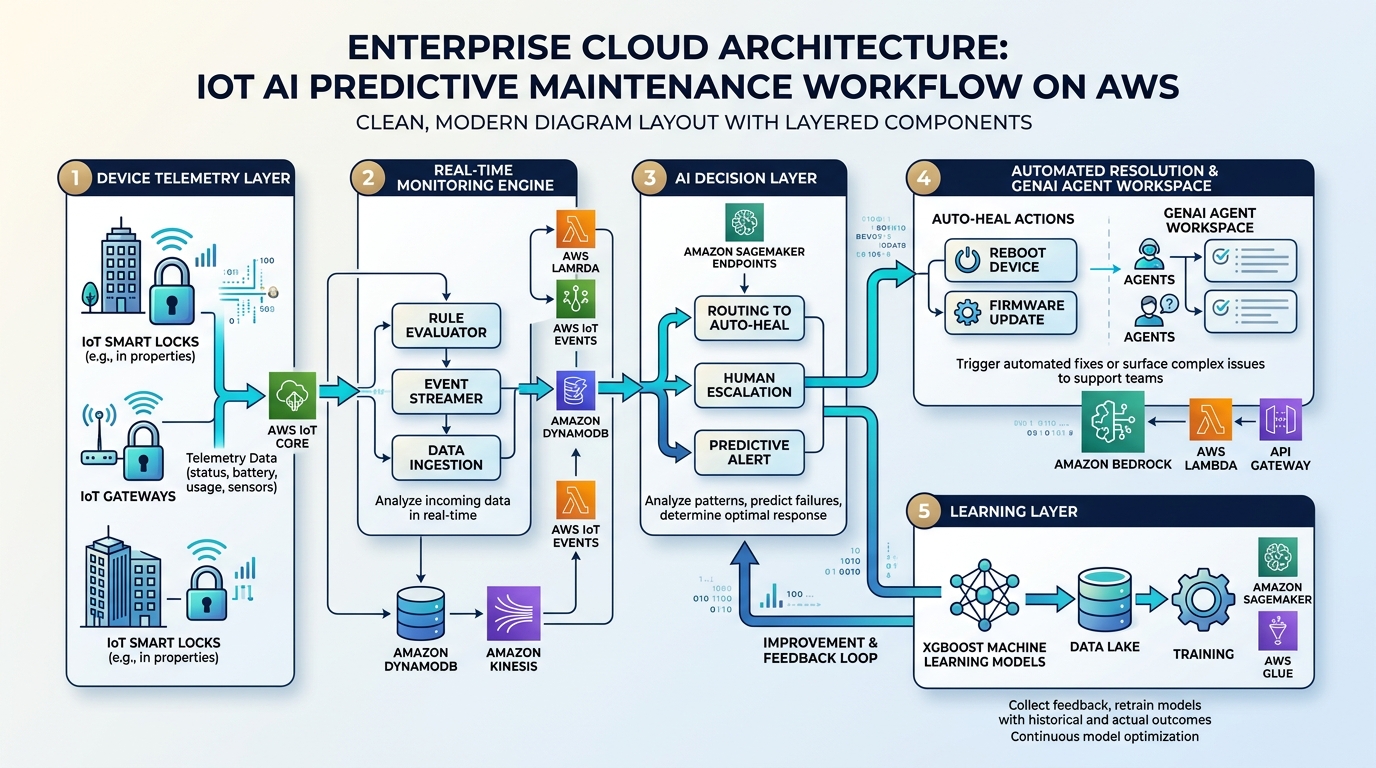
The platform operates as an intelligent overlay on top of existing infrastructure — no core devices were modified, and no data was migrated. Five logical layers form a continuous loop that learns over time.
 
Enterprise Cloud IoT AI Architecture Diagram
Preview
 
Five-Layer Flow Summary
 
Layer 1
Device Telemetry Layer

473,637+ smart locks and facility gateways stream real-time operational telemetry into AWS IoT Core — tracking battery voltage, wireless signal strength, firmware version, lock/unlock cycle logs, and operational errors.

Layer 2
Real-Time Monitoring Engine

A high-throughput serverless rule evaluation engine processes incoming telemetry every 5 minutes against 22 granular failure signatures. State transitions and anomalous events are enriched and stored in Amazon DynamoDB.

Layer 3
AI Decision & Routing Layer

The real-time decision engine classifies events instantly into three execution channels: autonomous auto-healing (Path A), agent escalation with Generative AI assistance (Path B), or predictive maintenance dispatch (Path C).

Layer 4
Automated Resolution & GenAI Workspace

Automated commands (credential synchronizations, device reboots, parameter recalibrations) execute over secured backchannels. For complex human escalations, Amazon Bedrock generates synthesized diagnostic summaries and next-best actions for agents in under 3 seconds.

Layer 5
Continuous Learning & Model Optimization

Three custom XGBoost models hosted on Amazon SageMaker analyze historical degradation curves daily. Telemetry trends predict battery depletion 30 days ahead and gateway disconnects 24 hours ahead. Real-world remediation outcomes continuously feed back to refine detection thresholds and expand auto-healing coverage.

 
Success Metrics
 
The platform fundamentally transformed the client's support model across every measurable operational dimension.
 
< 5 min
Detection Latency
Previously: tenant complaint
≥ 90%
Auto-Resolution Rate
Software-fixable issues
< 3 sec
AI Context Delivery
To agent, zero manual search
3 Models
Predictive ML Suite
Battery · Connectivity · Hardware
 
 
Operational Transformation: Before vs. After
MetricBeforeAfterImpact
Device failure detectionReactive — hours to days< 5 minutesProactive by design
Software issues — resolution methodTechnician dispatchAutomated commandEliminated unnecessary visits
Support agent context gatheringMinutes per call, multiple systemsAI-prepared in < 3 secondsAgents focus on decision, not research
Battery failures — advance warningNone30-day predictive alertResolved before tenant impact
Connectivity failures — advance warningNone24-hour predictive alertPrevented before occurrence
Support call volumeBaselineMeasurably reducedIssues resolved before tenants call
Average Handle Time (AHT)BaselineReducedAI context eliminates search time
First Call Resolution (FCR)BaselineImprovedComplete picture available at first contact
 
 
What Makes the AI Genuinely Effective Here
 
AI delivers maximum ROI when trained on domain-specific operational data, deployed in an active feedback loop, and governed by strict safety bounds.
 
Trained Exclusively on Fleet Telemetry
 
The predictive models were trained exclusively on this client's real-world telemetry — not generic sensor benchmarks. They understand this fleet's nuanced battery drainage rates, gateway connectivity patterns, and climatic seasonality.
Closed-Loop Decision Feedback
 
Every automated resolution, human escalation, and predictive alert feeds back into continuous model retraining. The platform perpetually validates its predictions against ground-truth field outcomes.
Policy-Enforced Safety Boundaries
 
Automated device actions are strictly bounded. The platform never attempts autonomous resolution on security incidents or unverified device states — safety is enforced at the platform policy layer, not just in code.
 
 
Enterprise AI Engineering
About P3Fusion Engineering
P3Fusion Engineering designs and builds production AI platforms on AWS for enterprise clients. Our engagements deliver complete, production-ready systems — architecture, model development, and rollout — not proofs of concept.
 
✓
Production-Ready Deployments
Turnkey architecture, model training, and active fleet rollouts.
✓
Cloud-Native on AWS
Serverless IoT telemetry, automated decision engines & SageMaker.
✓
Engineered for Measurable ROI
Real-time auto-healing, < 5 min fault detection, and early warnings.
 
Scale Your Success with Confidence
 
P3Fusion is audited and certified by industry-leading third-party standards.