
We use essential cookies to make our site work. With your consent, we may also use non-essential cookies to improve user experience and analyze website traffic. By clicking “Accept,” you agree to our website's cookie use as described in our Cookie Policy and Privacy Policy. You can change your cookie settings at any time by clicking “Preferences.”
 
 
Real-Time Queue Management in Amazon Connect
 
Amazon Connect Dynamic Routing
Real-Time Queue Management
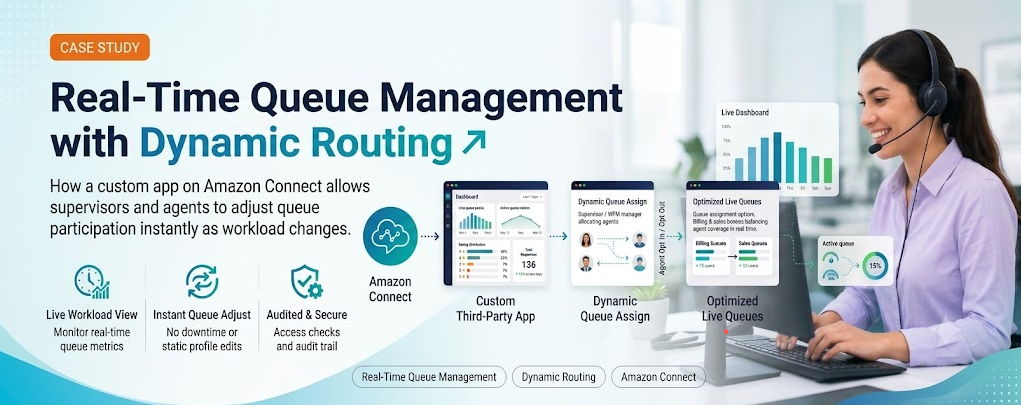
Adjusting agent participation in queues as live workload changes, using a custom application built on Amazon Connect routing profile APIs.
Real-Time
Queue Rebalancing
0
Operational Downtime
Dynamic
Agent Opt In / Out
100%
Audited Compliance
 
icon
Dynamic Agent Participation Based on Live Demand
icon
Zero Downtime Routing Updates via Connect APIs
icon
Autonomous Agent Opt-In / Opt-Out Controls
icon
End-to-End Audit Logging & Access Governance
 
The Challenge
 
In a contact center, demand never stands still. A billing run, an outage, or a campaign can fill one queue in minutes while another sits quiet. The best response is to move the right agents to the right queue quickly.
But when agent-to-queue assignment lives in static routing profiles, that response is slow. Profiles are edited by hand; changes are risky during live operations, and agents have no say. Below are five of the most common consequences.
#Impact AreaWhat It Costs the Business
1Staffing out of step with demandA queue backs up while agents who could help sit in other queues, because routing cannot follow the live workload.
2Longer waits and abandoned contactsCustomers queue for longer when cover cannot be moved quickly, and some give up.
3Static routing profilesEvery change means editing a routing profile by hand, which is slow, error-prone, and hard to reverse.
4Disruption to change routingUpdates risk affecting agents mid-shift, so teams avoid changing routing at the moments it matters most.
5Agents with no say in participationAgents cannot opt in or out of queues when workload or skills change, so supervisors handle every request manually.
 
The Client
 
Our client runs a contact center on Amazon Connect, with supervisors and workforce management (WFM) managers responsible for keeping queues staffed against live demand. Agents hold different skills and could serve several queues, depending on operational needs.
 
Two issues stood out:
 
Problem 1
Routing could not follow the live workload
Moving agents between queues meant changing routing profiles by hand, so cover reached a busy queue late, and sometimes after the peak had already passed.
Problem 2
Changes risked disrupting operations
Updating routing during the day could interrupt agents and live contacts, so teams held back from changing it when it mattered most.
 
What They Asked For
 
“
“Demand changes by the minute, but our routing only changes when someone edits a profile. We want supervisors and WFM managers to move agents in and out of queues as the workload and skills require, while the contact center keeps running. And agents should be able to opt in or out themselves, without us changing static routing profiles or taking anything down.”
— Head of Contact Centre Operations
 
How It Works
 
The solution adds a custom third-party app that sits alongside Amazon Connect. It reads live queue metrics, gives supervisors and WFM managers a simple way to act on them, and applies each change through the Amazon Connect routing profile APIs.
 
Step 1
Live Metrics Published

Calls and chats arrive in Amazon Connect, and real-time metrics (contact volume, waiting contacts, and available agents) are published continuously.

Step 2
Real-Time Workload View

The custom app reads those metrics and presents a live view of queue workloads alongside agent skills and current queue memberships.

Step 3
Dynamic Queue Adjustments

Supervisors and WFM managers see where cover is needed and choose which agents join or leave queues. Agents can also opt in or out autonomously.

Step 4
Access Checks & Audit Trail

The app verifies user authorization, checks permission guardrails, and records an immutable log of who changed what and when.

Step 5
Routing Profile API Updates

The app calls the Amazon Connect routing profile APIs to dynamically add or remove agent-queue associations, with zero manual edits in the console.

Step 6
Zero Downtime Real-Time Effect

Changes take effect immediately with zero downtime. New contacts route to the updated set of agents, and live metrics reflect the rebalanced workload.
 
Solution Architecture
 
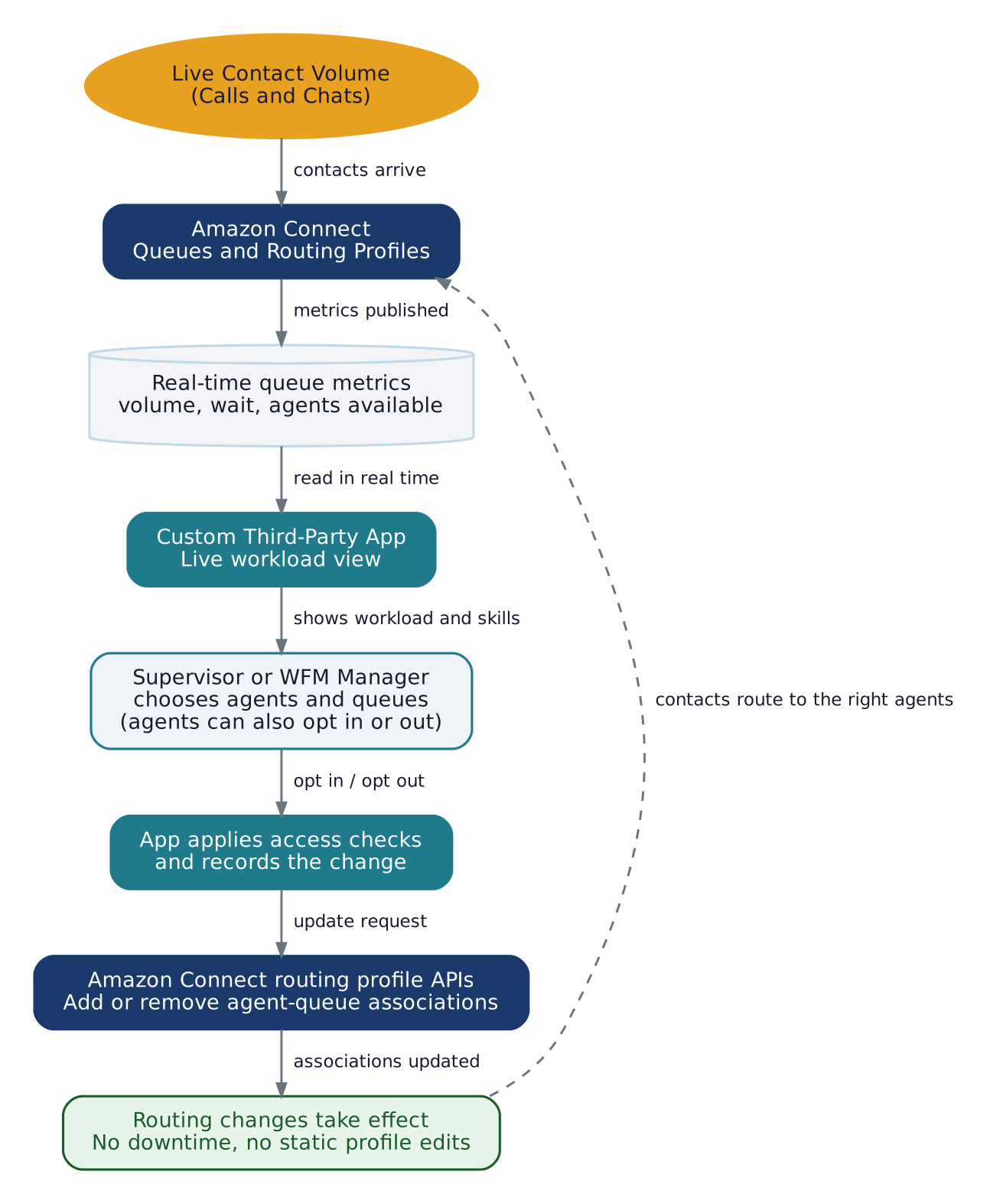
The diagram below shows the flow from live contact volume, through the app and the routing profile APIs, to routing that updates in real time.
 
Real-Time Queue Management Architecture Flow Diagram
Preview
Architecture Flow & Components
 
  1. Live Contact Ingestion: Calls and chats enter Amazon Connect, which continuously streams real-time queue volumes and agent availability metrics.
  2. Telemetry & Workload Dashboard: The custom third-party app consumes queue metrics, giving supervisors and WFM teams instant visibility into queue pressure.
  3. Dynamic Queue Rebalancing: Supervisors reassign agents based on live demand and skills, while agents can opt in or out autonomously.
  4. Access Verification & Audit Logging: Every membership update passes security checks and is logged to a complete operational audit trail.
  5. Automated API Updates: Amazon Connect routing profile APIs update agent-queue associations instantly with zero downtime or static console edits.
 
Practical Examples
 
Two situations at the same company, on the same day. In both, queue participation changes without a routing profile being edited by hand.
 
Scenario A — Supervisor Adds Cover
Demand Cleared
Situation:A billing queue builds up after a payment run, while general enquiries is quiet.
What Happens:
  • Supervisor sees the billing queue wait rising in the app
  • Selects five general enquiries agents with billing skills
  • Adds them to the billing queue with one click
  • Waiting contacts clear within minutes
Outcome: Cover moves to where the demand is, with no profile edits and no downtime.
Scenario B — Agent Opts Out
Autonomous Choice
Situation:Mid-shift, an agent is asked to focus on a priority callback list.
What Happens:
  • Agent opts out of the sales queue in the app
  • Queue association is removed in real time
  • New sales contacts route to other agents seamlessly
  • Agent opts back in when callback work is complete

Outcome: Participation follows the agent’s real work, without waiting on a supervisor’s manual change.
 
In both cases the change was made in moments, took effect straight away, and was recorded in the app’s audit trail.
 
Before vs. After
 
The difference dynamic queue management makes to operational agility, agent involvement, and customer wait times.
 
AreaBeforeAfterImpact
Adjusting queue participationChanging which agents served which queues meant editing static routing profiles, usually by a limited set of administrators.Supervisors and WFM managers adjust agent-queue associations from one app, as the workload changes.Unified Control
Speed of responseChanges were slow and often held back to avoid disruption, so cover arrived after the peak had passed.Changes take effect in real time, so cover can be moved while the queue is still building.Real-Time Response
Availability & UptimeRouting changes risked affecting live operations, so teams avoided making them at busy times.Updates are made through the APIs with no downtime and no interruption to agents.Zero Downtime
Agent involvementAgents had no way to opt in or out of queues themselves.Agents can opt in or out where the business allows, within the same controls.Flexible Participation
 
Key Results
 
Following the introduction of real-time queue management, the client gained five clear operational improvements.
 
Real-Time
Workload Driven
Agent-queue changes driven by live volume, not forecasts.
Zero
Downtime Required
No static routing profile edits or operational pauses needed.
Faster
Queue Coverage
Cover arrives while the queue is building, not after the peak.
Shared
Team Control
Direct control for supervisors, WFM teams, and agents.
Audited
Full Governance
Complete audit trail recording who changed what and when.
 
Key Learnings
 
Delivering this solution produced four insights about managing queue participation in real time.
 
Routing should follow the workload
 
Demand changes during the day. When queue membership can change just as quickly, staffing follows the live volume instead of the static forecast.
Put the controls with the people who see the problem
 
Supervisors and WFM managers see queue pressure first. Giving them a simple way to act removes the delay of waiting for an administrator to edit profiles.
Change routing without touching static profiles
 
Updating agent-queue associations through the Amazon Connect APIs avoids hand-editing routing profiles and keeps live contact center operations running uninterrupted.
Add guardrails alongside the freedom
 
Real-time changes need access checks and an audit trail, ensuring that operational flexibility never comes at the cost of management control and compliance.
 
Want to Build Something Similar?
Ready to Rebalance Queues in Real Time on Amazon Connect?
This solution uses a custom app on top of the Amazon Connect routing profile APIs to adjust agent-queue associations in real time. If your team wants to move cover to where demand is, without static profile changes or downtime, reach out to discuss how a similar approach could work for you.
✓
Demand-Driven Staffing
Match agent capacity to real-time spikes
✓
Zero Operational Downtime
Direct API updates with no console editing
✓
Full Audit Compliance
Granular permissions & change logging
 
Scale Your Success with Confidence
 
P3Fusion is audited and certified by industry-leading third-party standards.