

We use essential cookies to make our site work. With your consent, we may also use non-essential cookies to improve user experience and analyze website traffic. By clicking “Accept,” you agree to our website's cookie use as described in our Cookie Policy. You can change your cookie settings at any time by clicking “Preferences.”
 
 
Routing Assist
Zero Manual Case Identification Required
100% Issue Classification Accuracy
80% Case Context Delivered to Agents


Overview
 
Many organizations with customer-facing contact centers face a common operational challenge: connecting customers to the right team while providing agents with sufficient context to resolve issues efficiently. Customers often describe their problems in their own words rather than using predefined categories, problem codes, or support terminology.
 
As a result, agents spend valuable time gathering information, identifying the nature of the issue, determining whether an existing case already exists, and deciding how the interaction should be handled.
 
The Challenge
 
In large support organizations, this creates several operational challenges: Repetitive Customer Conversations, Inconsistent Issue Classification, Delayed Resolution Times, Difficulty Identifying Existing Cases, and Inefficient Routing. The challenge is no longer just about routing a call—it is about ensuring every interaction starts with understanding.
 
Key Challenges
 
Repetitive Customer Conversations
 
Customers are frequently required to explain the same issue multiple times as they are transferred between teams or agents who lack the necessary context.
Inconsistent Issue Classification
 
Different agents may categorize similar issues differently, leading to inconsistent case management, reporting, and routing decisions.
Delayed Resolution Times
 
A significant portion of each interaction is spent understanding the customer's problem rather than actively working toward a resolution.
Difficulty Identifying Existing Cases
 
Customers often call regarding previously reported issues, but determining whether the interaction relates to an existing case requires manual investigation and review.
Inefficient Routing
 
Without a clear understanding of the customer's intent, calls may be routed to the wrong queue, resulting in unnecessary transfers and increased customer effort.
 
The Client — Two Problems Compounding the Challenge
 
Many organizations operate large-scale customer support centers that manage a broad range of customer inquiries across multiple products and services. As customer interactions continue to grow, support teams often encounter operational challenges that can significantly impact both customer experience and agent productivity.
 
Problem 1: Agents Begin Conversations Without Context
 
When customers connect to the contact center, agents often have little or no information about why the customer is calling. The first several minutes of every interaction are spent gathering details, identifying the issue, determining the appropriate category, and understanding the customer's intent.
 
Customers must repeatedly explain their situation before meaningful assistance can begin. This increases handling time, reduces agent efficiency, and creates a frustrating experience for callers seeking immediate help.
Problem 2: Existing Customer Issues Are Difficult to Identify
 
Many customers call regarding issues they have already reported in the past. However, identifying whether a call relates to an existing case often requires manual investigation by the agent.
 
Without an automated way to recognize previous issues, agents may create duplicate cases, route customers to the wrong team, or spend valuable time searching through customer history before acting.
 
Both challenges stemmed from the same underlying issue: the contact center lacked an effective mechanism to identify customer intent before routing interactions. As a result, interactions were routed without sufficient context, requiring agents to spend additional time gathering information and customers to repeat details that had already been provided, leading to longer handling times and a less efficient support experience.
 
 
Solution Workflow
 
An AI-powered routing assistance capability can be integrated at the beginning of the contact flow to identify customer intent before an interaction reaches an agent.
 
• Step 1 — Understand the Customer's Intent:
At the start of an interaction, the AI assistant engages with the customer to understand the nature of their inquiry. Customers can describe their issue in their own words.
 
• Step 2 — Classify the Issue:
Using the client's predefined business taxonomy, the AI analyzes the conversation and identifies the appropriate category, problem, and subproblem associated with the customer's request.
 
• Step 3 — Identify Existing Cases:
The AI reviews the customer's profile and searches for related cases that match the identified issue. If a relevant case already exists, the AI confirms the relationship and links the interaction to the existing case.
 
• Step 4 — Route with Complete Context:
The interaction is routed to the appropriate queue based on the identified issue. The agent receives either the existing case or a newly created case, along with complete issue details.
 
 
Two Scenarios — One Solution
 
Scenario A: Existing Case Identified
 
A customer calls regarding an issue they previously reported. The AI assistant identifies the related case, confirms it with the customer, and routes the interaction with the existing case attached. The agent receives the call with complete case history and can continue the conversation immediately.
Scenario B: New Case Created and Routed
 
A customer calls with a new issue. The AI assistant determines the category, problem, and subproblem, creates a new case, and routes the interaction to the appropriate queue. The agent receives the call with the newly created case and complete issue details.
 
Whether the issue is new or existing, Routing Assist ensures every interaction reaches the right team with the right case and complete context.
 
Before vs. After — The Operational Difference
 
AREA
WITHOUT THIS SOLUTION
WITH THIS SOLUTION
 
1. Customer explains the issue
The agent begins the conversation with little context and spends the first several minutes understanding the customer's problem.
Customer intent is already understood
 
The AI captures the customer's intent before routing. The agent receives the interaction with complete issue context.
2. Customer calls about an existing issue
The agent manually searches for related cases and determines whether the issue has been reported previously.
Existing case identified automatically
 
The AI finds related cases and routes the interaction with the appropriate case attached.
3. New issue classification
Agents manually determine the category, problem, and subproblem, leading to inconsistent classification and routing.
Automatic issue classification
 
The AI identifies the correct category, problem, and subproblem based on the customer's conversation.
4. Agent receives the interaction
The agent starts with limited information and must gather details during the call.
Agent receives complete context
 
The agent receives the call with the existing or newly created case, issue description, classification details, and relevant history.
 
 
Architecture Components
 
Architecture Diagram
Preview
Components
 
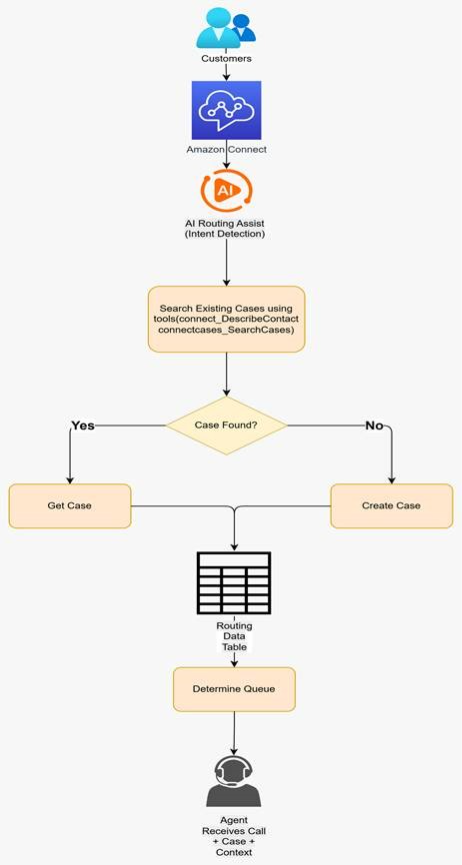
  1. Amazon Connect: Amazon Connect receives the inbound customer call and invokes the Routing Assist workflow before the interaction reaches an agent.
  2. AI Routing Assist (Intent Detection): The AI assistant engages with the customer to understand the reason for the call. Based on the conversation, it identifies the customer's intent and classifies the interaction.
  3. Amazon Connect Tools: The AI leverages Amazon Connect tools to gather customer context and identify related cases (connect_DescribeContact, connectcases_SearchCases).
  4. Routing Data Table: A centralized routing data table maps Categories, Problems, and Subproblems to the appropriate support queues.

 
Key Learnings
 
Customer intent should be understood before routing
 
The quality of a customer interaction improves significantly when the system understands the reason for the call before an agent becomes involved.
Context reduces customer effort
 
When agents receive complete case information upfront, customers spend less time repeating their issue and more time receiving assistance.
Intelligent routing improves efficiency
 
Accurate classification and routing ensure that interactions reach the teams best equipped to resolve them.
Better conversations start with better information
 
Providing agents with the right context at the right time enables faster resolutions and more productive customer interactions.
 
 
Scale Your Success with Confidence
 
P3Fusion is audited and certified by industry-leading third-party standards.