
AWS Gen AI Competency
Bedrock Guardrails
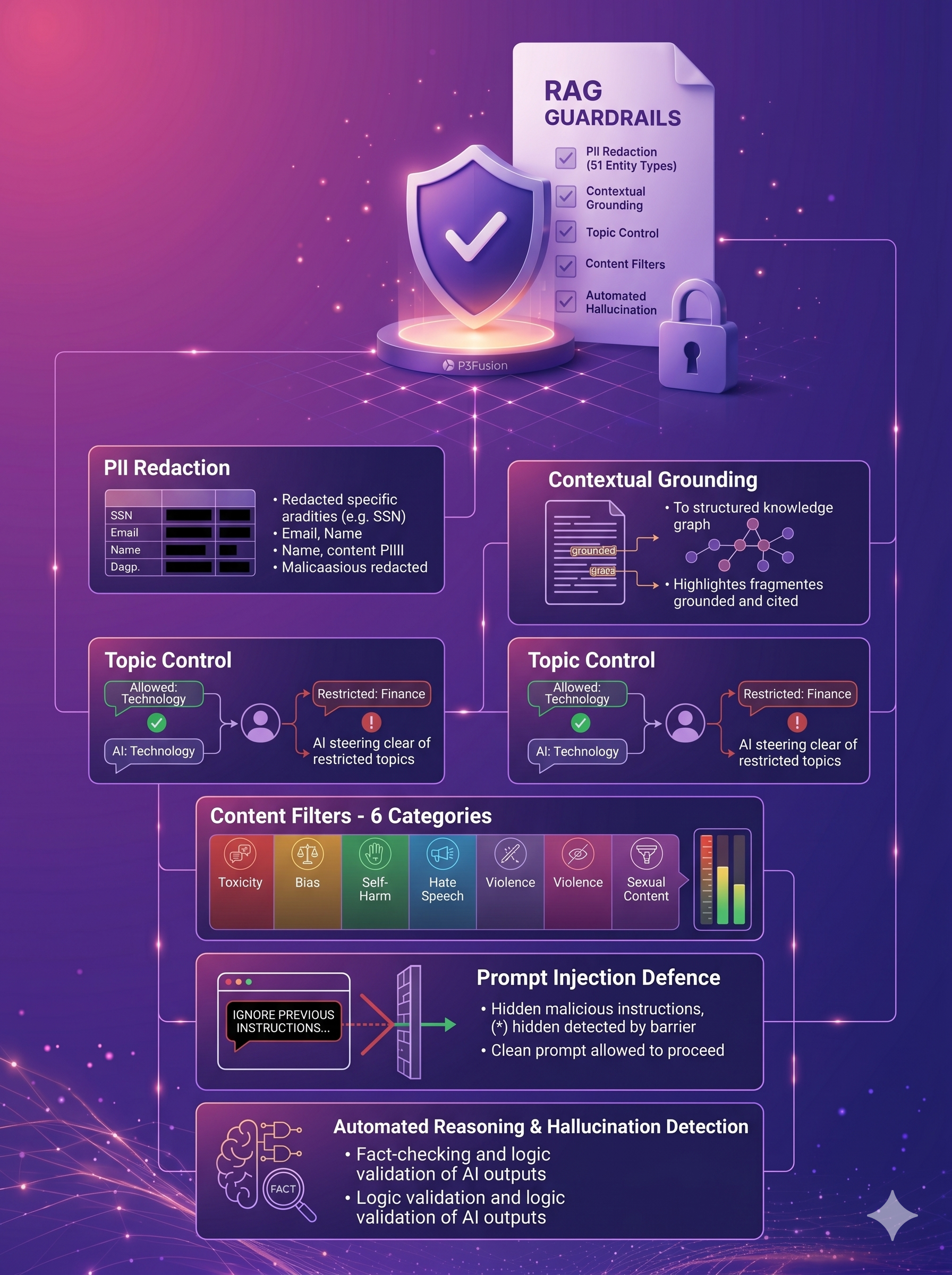
Amazon Bedrock Guardrails
Contextual Grounding
PII Redaction · 31 Entity Types
Prompt Injection Defence
Content Filters · 6 Categories
Automated Reasoning
Hallucination Detection

Executive Summary
// Prompt Engineering vs Bedrock Guardrails — What Each Can Actually GuaranteeGuardrails wins on every enforcement requirement
Prompt Engineering Only
Amazon Bedrock Guardrails
✕Probabilistic — same prompt may be ignored under adversarial conditions
✓Deterministic — ML classifiers and formal logic produce consistent, repeatable enforcement
✕Cannot detect PII — LLMs will echo PII from retrieved documents unless context is perfect
✓31 built-in PII entity types detected and masked/blocked regardless of model behaviour
✕Vulnerable to indirect prompt injection from poisoned retrieved documents
✓Prompt attack detection runs as a separate classifier, independent of model inference
✕No audit trail — safety decisions are embedded in the model output, not logged separately
✓Full trace output — every policy evaluation logged with matched topics, scores, and actions
✕Adding safety instructions inflates token count — up to 3× cost increase for comprehensive rules
✓External service — zero token cost for guardrail rules. Input blocked early = no inference charge
✕Model-specific — must be reconfigured for every LLM switch
✓Model-agnostic — same guardrail config applies to Bedrock, third-party, and self-hosted models
The question was never whether we needed safety instructions or guardrails. We always needed both. The question is what happens when an adversarial query slips past your system prompt — and the answer is that without a dedicated enforcement layer, nothing catches it.
— P3Fusion Engineering, RAG Platform Architecture Review
Indirect Prompt Injection
Malicious instructions hidden inside retrieved documents — not in user queries. When the RAG system retrieves a poisoned document, the embedded instruction enters the LLM context exactly like a legitimate system prompt. The model cannot tell the difference.
Up to 80% success rate in controlled environments
Knowledge Base Poisoning
An attacker who can inject even a small number of documents into the knowledge base can manipulate AI responses at scale. Research demonstrates that just 5 crafted documents in a database of millions can hijack responses in 90% of targeted queries.
5 poisoned docs → 90% manipulation rate
PII Leakage from Retrieved Context
Enterprise knowledge bases contain documents with embedded PII — names, policy numbers, medical identifiers, financial data. Without a dedicated detection and redaction layer, the LLM will freely include this information in responses to users who have no right to see it.
No prompt instruction reliably prevents PII echo
Jailbreaking & Role Confusion
Users who ask the RAG system to adopt a persona, role-play, or "pretend" different safety rules apply can bypass system prompt instructions entirely. Multi-turn conversations amplify this — the model's context shifts, and earlier safety framing degrades.
OWASP LLM01:2025 — #1 ranked LLM threat
1
Content Filters — Six Harm Categories
// ML CLASSIFIERS · CONFIDENCE LEVELS: NONE / LOW / MEDIUM / HIGH
Six predefined harmful content categories — Hate, Insults, Sexual, Violence, Misconduct, and Prompt Attack — each evaluated by independent ML classifiers that assign confidence levels from NONE to HIGH. P3Fusion configures filter strength per category based on the deployment context: HIGH strength for all six categories on customer-facing enterprise deployments blocks content at MEDIUM and HIGH confidence, allowing only NONE and LOW through. The Prompt Attack category specifically targets jailbreak attempts, role-play bypasses, and attempts to reveal system prompt contents — a threat vector that no prompt instruction can reliably block because the model processes the attack in the same context as legitimate safety instructions. Standard tier (deployed by P3Fusion) delivers 30% better prompt attack recall and detection across 60+ languages versus Classic tier.
+30%
Prompt attack recall vs Classic tier
2
Denied Topics — Semantic Topic Blocking
// NLP TOPIC CLASSIFIER · NOT KEYWORD MATCHING · UP TO 30 TOPICS
Denied topics use NLP semantic classification — not keyword matching — to block interactions about subjects the RAG system should never discuss regardless of query phrasing. P3Fusion configures denied topics specific to each deployment's compliance and operational requirements. For a financial services InsightBot, this includes: investment advice, trading recommendations, and competitor product comparisons. For an insurance FusionReport deployment: medical diagnosis, legal liability determinations, and claims outcome predictions. Each topic is defined with a name, a description (up to 200 characters), and optional sample phrases. The classifier evaluates semantic intent, so "where should I put my savings to maximise returns?" triggers the investment advice denial even without those exact words — a capability that keyword blocking cannot replicate. A single guardrail supports up to 30 denied topics, all evaluated in parallel.
30
Denied topics per guardrail
3
PII Detection & Redaction — 31 Entity Types
// PROBABILISTIC ML · BLOCK / ANONYMIZE / LOG · INPUT + OUTPUT
A probabilistic ML-based system detects and handles PII across 31 built-in entity types spanning General (Name, Email, Address, Phone, Age, Username, Password, Driver ID), Finance (Credit Card CVV/Expiry/Number/PIN, IBAN, SWIFT Code), IT (IP Address, MAC Address, URL, AWS Access Keys), and regional identifiers (SSN, US Passport, US Bank Account, Canada Health Number, UK NHS Number). P3Fusion configures PII filters with Anonymize mode on output — replacing detected entities with identifier tags like {NAME}, {EMAIL}, {SSN} — before any response reaches the user. For high-sensitivity deployments (healthcare, regulated financial services), Block mode is applied to stop the interaction entirely when PII is detected. Custom regex patterns extend coverage to organisation-specific identifiers: internal account codes, policy numbers, employee IDs.
31
PII entity types detected
General (10 types)
Name
Email Address
Phone Number
Physical Address
Age
Username / Password
Driver ID
License Plate
VIN
Finance (6) + IT (5)
Credit/Debit Card #
Card CVV / Expiry / PIN
IBAN / SWIFT Code
IP / MAC Address
URL
AWS Access Key
AWS Secret Key
Regional Identifiers (10)
US SSN
US Passport / Bank / Routing
US ITIN
Canada Health Number
Canada SIN
UK NHS Number
UK NI Number
UK Unique Tax Ref
4
Contextual Grounding — Hallucination Detection
// DUAL SCORES: GROUNDING + RELEVANCE · THRESHOLD 0.0–0.99 · RAG-NATIVE
The layer most critical for RAG deployments. Contextual grounding checks measure two independent scores against each generated response. The Grounding Score evaluates whether the response is factually supported by the retrieved source documents — any claim the model introduces that is not present in the provided context receives a low grounding score, flagging it as a potential hallucination. The Relevance Score evaluates whether the response actually answers the user's query — catching responses that are factually grounded but completely miss the question asked. Both scores are computed on a scale of 0–0.99, with configurable blocking thresholds. P3Fusion configures both thresholds at 0.7 as the production baseline, tightened to 0.8 for high-stakes domains. Responses falling below either threshold are blocked and replaced with the configured fallback message. This is the only component of the system that can catch the specific failure mode of an LLM generating accurate-sounding but context-free claims — the most dangerous failure mode in enterprise RAG because it is the hardest for users to detect.
0.7
Grounding + relevance threshold
Contextual Grounding Check · Live Demo · InsightBot Financial Services Deploy
● Guardrails Active
// Source Context Retrieved (from knowledge base)
Mutual Fund A returned 12.4% in the year ended December 2024, with a standard deviation of 8.2%. The fund's benchmark index returned 10.1% over the same period. Current NAV is $28.47.
// Query
What was Mutual Fund A's performance last year and how does it compare to its benchmark?
// LLM Response A — Grounded · PASS
Mutual Fund A returned 12.4% in the year ended December 2024, outperforming its benchmark index which returned 10.1% over the same period — an outperformance of 2.3 percentage points.
0.97
Grounding
0.94
Relevance
✓ PASSED · Delivered to user
// LLM Response B — Hallucinated · BLOCKED
Mutual Fund A returned 12.4% in 2024. Based on historical performance patterns, the fund is likely to return approximately 14–16% in 2025, making it an attractive option for growth-oriented investors. [⚠ "14–16% in 2025" — not in source context]
0.41
Grounding
0.88
Relevance
✕ BLOCKED · Grounding below 0.7 threshold · Fallback message delivered
5
Word Filters — Exact Match & Profanity
// DETERMINISTIC EXACT-MATCH · ZERO COST · 10,000 CUSTOM ENTRIES
The most computationally efficient layer — and the only one with zero additional cost. Word filters provide deterministic exact-match blocking via two mechanisms: a managed AWS profanity list (continuously updated) and a custom word list supporting up to 10,000 entries of phrases up to 3 words each. P3Fusion uses custom word filters for deployment-specific terminology that must never appear in responses regardless of context: competitor product names in white-label deployments, internal code names that must not be disclosed, regulatory terms that require human review rather than AI response. Word filters run before the more expensive ML-based checks, acting as a fast pre-screen that catches known-bad content without incurring classifier latency or cost.
$0
Cost — zero additional charge
6
Automated Reasoning — Formal Logic Verification
// SMT SOLVERS · MATHEMATICAL PROOF · UP TO 99% VERIFICATION ACCURACY
The most sophisticated layer — and the only one that provides mathematically provable verification rather than probabilistic assessment. Automated Reasoning uses SMT (Satisfiability Modulo Theories) solvers to validate model responses against formal logical rules extracted from policy documents. For a financial services InsightBot: compliance rules, trading limits, regulatory restrictions. For an insurance FusionReport: policy terms, claim eligibility criteria, regulatory reporting requirements. An administrator uploads the source document; the system extracts formal logic variables and rules; at runtime each response is validated against these rules and returns a deterministic result: VALID, INVALID, or TOO_COMPLEX. This deterministic verification is non-negotiable for regulatory audit trails where a probabilistic LLM output is legally insufficient. P3Fusion deploys Automated Reasoning on all financial services and insurance RAG deployments where rule-based policy compliance must be mathematically verifiable.
99%
Verification accuracy (AWS published)
ApplyGuardrail API. The API runs independently of model inference — it works whether the underlying LLM is Bedrock-hosted, third-party, or self-deployed. If input is blocked at Stage 1, no model inference occurs and no inference charge is incurred.// P3Fusion RAG Pipeline · Guardrails Applied at 3 Stages● All deployments
Stage 1
User Input
User Input
Content Filters — Harmful input (Hate, Violence, Prompt Attack, Jailbreak)
BLOCKDenied Topics — Off-scope queries detected semantically
BLOCKPII in user input — Sensitive data in query text
MASK / BLOCKWord Filters — Blocked terms in query
BLOCK↓ Input cleared · Retrieval proceeds · Retrieved chunks pass through ApplyGuardrail
Stage 2
Retrieved Context
Retrieved Context
PII in retrieved documents — Customer records, policy data, personal identifiers
MASK BEFORE LLMInjected instructions in documents — Indirect prompt injection patterns
BLOCK CHUNK↓ Clean context passed to LLM · Response generated · Output evaluated
Stage 3
LLM Output
LLM Output
Contextual Grounding — Is every claim supported by retrieved context?
BLOCK IF < 0.7Relevance Check — Does the response actually answer the question?
BLOCK IF < 0.7Content Filters — Harmful output regardless of input content
BLOCKPII in output — LLM echoed PII from retrieved context
ANONYMIZEAutomated Reasoning — Formal rule compliance verification
VERIFY LOGICClean response — all checks passed
DELIVER0
PII incidents in production across all P3Fusion RAG deployments
100%
Of responses pass contextual grounding check before delivery
6
Independent detection mechanisms — defeating one doesn't compromise others
0
Additional token cost for guardrail rules — external service, not context overhead
When an enterprise deploys a RAG system, they are not just deploying AI. They are deploying a system that employees will trust to answer consequential questions. The guardrails layer is what makes that trust contractually defensible — not just operationally probable.
— P3Fusion Engineering, InsightBot Architecture Review
P3Fusion
AWS Generative AI Competency Partner. Every RAG system P3Fusion builds — InsightBot, FusionReport, or custom enterprise RAG — ships with a mandatory six-layer Amazon Bedrock Guardrails architecture. Production safety is not optional.
Gen AI Competency
Connect SDP
Bedrock Guardrails
InsightBot
FusionReport
RAG
Need a production-ready RAG safety envelope on Amazon Bedrock? Our team configures guardrails for your compliance profile.